“A man is literally what he thinks, his character being the complete sum of his thoughts.”
—James Allen
Sunday, September 24, 2006
Taormina For Your Next Vacation Spot
History
Taormina is located in Sicily, Italy. In ancient times it was colonized by the Greeks as the town of Taurmenion (Ταυρομένιον), dating back to 400 BCand later to Roman control in 212 BC.
Taormina, located in the province of Messina, along with the stunning Aeolian Islands and the ancient city of Milazzo can be reached by car from Messina to the north and the city of Catania from the south. Taormina has been a famous tourist destination for more than 200 years. The beaches remarkably warm and with high salt content, are incredibly beautiful and easily accessible via a Funicular railway.
Isola Bella, south of Taormina, is a breathtaking nature reserve.Capo Sant’ Andrea grottos are available via guided tours. Taormina is built on a hilly coast with Mount Etna on the horizon only a forty-five minute drive from the city.
The remain of the Teatro Greco, the “Greek Theatre”, are not Greek at all, as this theatre was rebuilt by the Romans on the site of the original theatre. During the 2nd century it was expanded to 109 meters in diameter, this theatre is the 2nd largest in Sicily and frequently used for operatic, theatric and concert performances, the view from here is stunning.
In the 19th century Taormina gained notoriety as the city where Wilhelm von Gloeden worked photographing predominantly male nudes.
During the 20th century the town became a colony of expatriated artist, intellectuals and writers. D. H. Lawrence stayed at the Fontana Vecchia and wrote some of his poems, stories, essays, novels (Lady Chaterlly's Lover) and a travel book, Sea and Sardinia from 1920 to 1922. The Taormina Film Festival has been held here for more that fifty years, with international stars viewing films on a screen erected in the Greek Theatre.
If you're visiting, July and August are the busiest months. If you prefer a more relaxed stay, any other month will be more pleasant. Giardini-Naxos, 3 Km away, offer resorts for the packaged tour. Mount Etna is only a 45 minute drive.
Taormina is the place to relax and hang out. Stroll and explore the narrow streets and discover views that will remain with you forever. Taormina's Friends Club has an extensive site devoted to this city, you'll find lots of information that will help you if you decide to visit.
I leave you with this quote from their website. "Finally if you really want to feel at ease like a true Sicilian , just buy your favorite paper , sit down at some of the several elegant open air cafès , forget what time it is , order your favorite drink or maybe a cappucino , enjoy the piano playing , breath deeply the sweet atmosphere all around you and just relax … that's probably the best treat of Taormina !!!"
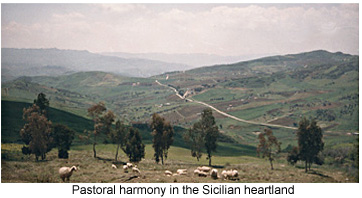
I was born in Sicily, Italy in a small town called Regalbuto. Although I grew up abroad, my heart has a special spot for this land and its people whom I so adore. This is a small tribute to the island I love. Brief History
Organized human presence in Sicily began during the Mesolithic Age (circa 10,000 BC). Drawings found in the Addaura Cavern, beneath the slopes of Mount Pellegrino near Palermo, have been dated to about 8000 BC. The Sicanians are the earliest native Sicilian civilization followed by the Sicels (from whom the island takes its name) and Elymians. The Sicels come from the Italian mainland peninsula, while the Elymians came from, via Africa, what is now Turkey. The Phoenicians began to arrive in Sicily around 800 BC. They colonized the Northwest part of the island and established the cities of Palermo, Mozia and Solunto. Around the same time the Greeks colonized the Eastern part of the island and established Naxos, Catania and Messina. Though the three Sicilian civilizations were eventually amalgamated with Hellenic culture, the Greeks often found themselves in conflict with the Carthaginian --partly because of Greco-Phoenician conflicts in the eastern Mediterranean.
The Sicilians of today are said to be a "mixed race" (i.e. varied ethnic group) descended from early Sicilians (Sicani, Sicels, Elymians) and the peoples who subsequently conquered or colonized Sicily: Phoenicians, Greeks, Carthaginian, Romans, Byzantine Greeks, Saracen Arabs, Normans, and to some extent Longobards, Goths, Angevin French, Aragonese and Spanish. A number of Sicilians are descended from Albanians who settled in several communities in the sixteenth century. Sicilian genetics and ethnology are indeed complex, a fact confirmed by genetic studies and known history. Early History (1000 BC - AD 500 Phoenician influence had made itself felt since around 700 BC in western Sicily, where this seafaring people founded Palermo, Erice, Mozia and Solunto, coastal settlements that facilitated commerce and trade. The Carthaginian also made incursions into the same areas. They ffounded Himera (near Termini Imerese) around 650 BC but were defeated there by Greeks in 480 BC. It was the Greeks whose mythology and folklore would assert the greatest influence on Sicily, and Sicily's museums are filled with religious artifacts and statues reflecting the important culture whose language, philosophy and law would form the very foundations of Western civilization. Archimedes, the great mathematician and engineer, was born in Syracuse in 287 BC. By 262 BC, the Greeks had begun to make peace with the Romans, who sought to annex Sicily as the Empire's first province. They eventually succeeded, but only after much bloodshed in the Punic Wars. With Hannibal's defeat in 201 BC, the Romans consolidated their power not only in Sicily and Northern Africa, but over the entire Western Mediterranean. In 70 BC, Cicero was called to Sicily to argue against the island's corrupt governor, Gaius Verres, who fled in anticipation of being tried by the great orator. The trial is little more than a footnote to history, but Cicero's lengthy indictment of the governor contains many useful descriptions of the Sicily of those times.
Roman Sicily was prosperous. Only during the reign of Augustus was any attempt made to introduce the Latin language to any meaningful extent, and then only among the privileged classes and ruling elite.
Christianity made its first serious inroads into Sicily sometime after 200 AD, and a number of Sicilians were martyred in the century to follow. In 313, Emperor Constantine lifted the prohibition against Christians as the Roman Empire shifted its focus to the East, to Constantinople. Christianity grew rapidly in Sicily during the next two centuries.
Some Barbarian invasions followed as Vandals and Ostrogoths sacked the coasts, though these invaders remained, at most, for a few years. Goths also arrived but their influence was not a lasting one.
The Middle Ages (500 - 1500)
In 515, Sicily fell to the Byzantine general Belisarius. Naturally, the Christian Church in Sicily remained Eastern, which is to say Orthodox. It remained so until the twelfth century.
By the ninth century, Moors (Arabs) from North Africa were raiding Sicily. In 827, they attacked in force at the western end of the island and another conquest had begun. By 903, all of Sicily was in Saracen hands, controlled principally by three emirs, and Islam was the official religion. The Saracens were an Arab people, originally nomadic, related to the Moors. They tolerated Christianity and Judaism in Sicily, without encouraging either. In Sicily, the Saracens were rulers rather than colonizers, masters rather than governors. Because Islamic law could be harsh to non-believers, many Sicilian Orthodox converted, though precise numbers are not known. However, it must be said Arabic society and culture were advanced; under the Saracens the city of Panormus became Palermo and its splendor was said to rival that of Baghdad. For the first time in Sicily's history, the lemon and the orange were cultivated, complex irrigation systems were developed, and sophisticated mathematics introduced.
In 1061, a Norman lord named Roger de Hauteville crossed the Strait of Messina with his brothers and several hundred knights from Normandy, Lombardy and Southern Italy, defeating the Saracen garrison and establishing a foothold under cover of darkness. Unlike their Viking forebears, the Normans were unaccustomed to naval combat. Therefore, the conquest of Messina against Arab foes would serve as the blueprint for the battle at Hastings against the Saxons a few years later, and several knights actually fought at both battles. This was Roger's second attempt to land at Messina and, though it was successful, Palermo was still far away. It was captured only in 1071 following another epic battle. Sicily was again part of Europe.
Styled "Count of Sicily" by his knights, Roger brought the feudal system to his new dominion. His rule also brought with it religious freedom, multicultural artistic expression and national sovereignty. There was no serfdom and very little slavery. There were mosques, synagogues and plenty of churches, English bishops and Saracen imams. The Sicilians who didn't speak Sicilian or Arabic dialects spoke Norman French, and court decrees were issued in several languages, including Latin, Greek and Arabic. Count Roger's son, Roger II, was crowned King of Sicily in 1130 and ruled a dominion that included most of Italy south of Rome, with Palermo as its capital. It was the wealthiest realm of Europe, whose monarch wore Byzantine robes in the manner of an Eastern Emperor and kept a private harem in the style of an Arab emir. A mosaic in the Martorana Church depicts Roger clad as a Byzantine monarch wearing a robe of golden fleurs-de-lis on a blue field, the earliest known representation of what eventually became the heraldic symbol of the French kings. His descendant, King William II of Sicily, wed Joan, daughter of Henry II of England.
Idris, an Arab geographer in the court of Roger II, traveled across Sicily and authored what may be considered its first travel guide. He observed that castles had sprung up everywhere. The Golden Age of Sicily had begun.
In 1198, Frederick II (Stupor Mundi) Von Hohenstaufen, a descendant of the last Norman King of Sicily through a female line, ascended the throne and ruled for more than half a century. By now, the Golden Age of Sicily was in full flower. From Palermo's splendid royal palace, the enlightened Frederick ruled most of Italy and also parts of Germany as Holy Roman Emperor, though in truth he spent little time in Sicily. It was a peaceful era, and very few Sicilian knights took part in the Crusades and the other wars of the day. Stupor Mundi was the Latin nickname given to the brilliant Emperor admired across the Mediterranean and across the world.
Usually tolerant of Islam, Frederick and his German barons were unwilling to accommodate the many demands of the Muslims who still inhabited the Sicilian interior. For some years before 1220, Ibn Abbad, a Saracen leader, had acted as an independent sovereign, only to have his ambitions suppressed by the real sovereign of Sicily. But though Sicily's Church was gradually becoming Latinized, and the Pope approved of the local crusade against the Muslims (and Frederick's own Crusade to the Holy Land), the Papacy was not always happy with the sovereign's use of power.
Frederick's heirs proved themselves less able than he, and Sicilian independence came to an end with the defeat of the last Hohenstaufen at the Battle of Benevento in 1266. The Angevin dynasty of France ruled the island from Naples until 1282, when a bloody uprising, the War of the Sicilian Vespers, expelled Angevin troops and nobles from Sicily.
The political reasons for this war, described at length by Sir Steven Runciman in The Sicilian Vespers (Cambridge 1958), considered the landmark work on this historical period, were indeed rather complex. The local aristocracy was certainly involved, but so were several European monarchs and even the Pope. The Sicilian conflicts mirrored those between Guelphs and Ghibellines elsewhere in Italy. In the wake of the Vespers, during which the Sicilians had slaughtered most of the Angevins on their island, the barons offered their nation's Crown to Peter of Aragon, who gladly accepted. This led to the island's being ruled, except for brief periods, from Spain for the next four centuries.
Owing to various factors, particularly a dynastic interregnum, the Chiaramonte family seized a certain degree of feudal power for a time after 1350. Their wealth derived from confiscated estates that had belonged to the displaced Angevin feudatories before the Vespers, but with the King so far away, families like the Chiaramonte and d'Alagona vied for local power. The situation was only resolved in 1392, when Martin, grandson of the King of Aragon, arrived in Sicily to ascend the Throne and restore order among the unruly barons. Andrea Chiaramonte, the leader of the rebels, was executed at the castle now called the Steri, in Palermo's Piazza Marina, and a parliament was called. It wasn't the first and it would not be the last, but it was not particularly effective, and it led to few real reforms.
Modern History
The Modern Era
The Renaissance and Baroque certainly influenced Sicily internally, but to the rest of the world it was a colony, a kind of strategic province that the Great Powers could trade as a bargaining chip at key negotiations. The Inquisition, with all its horrors, was the strongest social force, and prompted the end of the few remaining mosques and synagogues, and the coercive conversion of the last Muslims and Jews.
With the discovery of the New World, Sicily's importance diminished, though it was still one of the most prosperous parts of Italy, despite an aristocracy intent on exploiting its resources and returning nothing. In 1713, Victor Amadeus of Savoy became King of Sicily, though he ruled the island from his family's traditional capital, Turin. In 1720, the Crown passed to the Emperor Charles VI of Austria, and in 1734 to Charles de Bourbon, son of the King of Spain.
Charles, who actually ruled from Naples, brought a degree of autonomy to Sicily and also to Naples, which had likewise been ruled from afar for some time. He built splendid palaces in his capital and made it the wealthiest, most opulent city in Italy, but spent little time in Palermo.
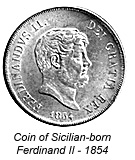
His son, Ferdinand I, found himself in Sicily during the early years of the nineteenth century, but not by choice. The King and his family were forced to flee Naples during the Napoleonic occupation, when British troops occupied Sicily. The Sovereign's grandson, Ferdinand II, was born at Palermo during this period, but the monarch and his son spent most of their time at the splendid Chinese Villa, set in a park at the foot of Mount Pellegrino, or at the Royal Hunting Lodge at Ficuzza, an estate in the mountains near Corleone. In 1812, Ferdinand signed the constitutional decree abolishing feudalism, thus abrogating the last land rights of the nobility. Though cut off from Naples, Sicily was enjoying an economic boom of sorts with the mining of sulfur.
With the expulsion of the French and the accords of the Congress of Vienna (1814-1815), Ferdinand returned to Naples. In 1816, he amalgamated the Neapolitan and Sicilian realms into one state, forming the Kingdom of the Two Sicilies.
By 1848, enough disillusion had developed to spawn a revolutionary spirit. The riot begun in Palermo quickly spread across the island and, to a greater or lesser degree, across Europe. (An analogy to the American protests of 1968 would not be inappropriate.) Though King Ferdinand II suppressed this revolution by force, he considered the situation serious enough to grant his subjects a constitution.
The seeds of dissent had been sown, however, and when a band of mostly Piedmontese troops led by Giuseppe Garibaldi landed in Sicily in 1860, the pious young King Francis II,son of the late Ferdinand II, proved himself ill prepared to meet a military challenge, even though he had Italy's largest army at his disposal. Sadly, a number of high military officers had already been bribed by the Piedmontese, while others saw no reason to fight for a King who seemed reluctant to act. Weapons had already been smuggled into Sicily to support the conquest, and the British fleet commanded by Admiral Rodney Mundy prevented the Sicilian ships from attacking Garibaldi's vessels at Marsala. Additional support soon arrived from Piedmont.
The west-to-east strategy of Garibaldi's campaign was the opposite of the Normans' Messina-to-Palermo strategy, though no less effective; Palermo was one of the first cities to fall but it was months before the fortress of Messina surrendered to the Piedmontese. In the meantime, cities where resistance to the Piedmontese invasion was evident were attacked, sacked and burned. The eastern Sicilian city of Bronte was all but destroyed. Randazzo, Castiglione and Regalbuto followed.
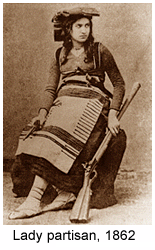
The rest of the Kingdom had fallen by March 1861, though there were pockets of armed resistance by partisans in the mountains of the mainland. There was never any declaration of war, and a false referendum (with an alleged majority of almost 99%) confirmed Francis' cousin, King Victor Emanuel II of Sardinia, as "King of Italy." (Francis himself was exiled and died in Trent, then part of Austria, in 1894; his descendants were illegally exiled until the Allied liberation of Italy from Fascist control in 1943-1945.)
A series of riots followed for several years, in Sicily and elsewhere in the South, and only the presence of thousands of Piedmontese troops could prevent the Sicilians from re-installing Francis II on the Throne. The new regime didn't only confiscate the national bank (and five million gold ducats from the Palermo Mint), whose assets dwarfed those of Piedmont, it executed more than 100,000 southerners between 1860 and 1870, civilians as well as partisans. Most were killed for little more than their loyalty to the Royal Family of Naples, and in very few cases were there trials; others were incarcerated in Alpine prisons for "treason." (This policy contrasted sharply with that of the Kings of the Two Sicilies, who frequently pardoned criminals.) In September 1866, an anti-Savoy revolt broke out in Palermo but was ruthlessly put down within a week. By December of that year, tens of thousands of Piedmontese troops had occupied Sicily to prop up the new regime. Most of the land holdings of the Church were gradually being confiscated by the new government, and with them numerous schools, which were closed. Most Sicilian schools had been administered by the monastic orders, and they were not immediately substituted by state institutions. This meant that illiteracy became more widespread, though previously its prevalence here had been no higher than in other parts of Italy.
For several generations, the cause of Italian unity was enshrined as a kind of national creed, in Sicily and elsewhere. It would be contradicted in 1946 during the brief reign of Victor Emmanuel's descendant, Umberto II, who signed the decree establishing the Sicilian Region as a semi-autonomous part of Italy. More astute historians now concede that a federalist union would have been better than a unitary, monarchical Italy with a shadowy democracy, and federalism is certainly advocated by many Italians today.
The decades following 1860 witnessed Sicily's slow economic decline as important new industries gradually emerged not in the South but in the North. Some of this was economic happenstance, but much was the result of punitive taxation and other national economic policies detrimental to the South. Until the 1860s, the Kingdom of the Two Sicilies (i.e. Naples and Sicily) was clearly the largest, wealthiest and most industrialized of the various Italian states. While Italian immigration prior to about 1870 had been primarily from the poorer northern regions, henceforth it was to be from the increasingly poorer South. Between 1890 and 1930, millions of southerners left for the Americas.
During the First World War, an inordinately high number of southerners died for their young nation, and the Fascist Government that came to power in 1922 did little to alter an unbalanced conscription policy that granted exemptions to those employed in northern factories. It is true that the regime's harsh laws sent serious criminals such as Mafiosi to prison, but they punished journalists and other innocent citizens as well. Even before the advent of Fascism, the Kingdom of Italy could not be said to have been a truly free or democratic nation, and by the 1930's life for many people was worse than it had ever been, despite the institution of old-age pensions and low-cost public housing --benefits which made many Italians overlook the less pleasant (and far less convenient) facts of torture by police officers and postal censorship by a special office.
Fascism's atrocious foreign policy led to Italy's becoming the first country ever cited by the United Nations for crimes against humanity (in connection with the invasion of Ethiopia). At home, the government disgraced the brilliant Arctic explorer Umberto Nobile, who left for America. (Today, most Italian high school students don't know that the second man to fly over the North Pole was an Italian.) Disgusted with Fascism, the gifted conductor Arturo Toscanini emigrated, choosing to live in New York. The racist laws prohibiting Jewish Italians from holding teaching jobs or government posts prompted Enrico Fermi, whose wife was Jewish, to emigrate, followed by a lesser-known Jewish Italian, Emilio Segre, the Nobel laureate who taught physics at the University of Palermo, where he discovered the first artificially produced element, technetium (Tc), in 1937. Both worked on the Manhattan Project. A number of citizens who remained in Sicily actively opposed Fascism, and at great personal risk; the writer Vitaliano Branchedi was an outspoken opponent, while Luigi Pirandello was an advocate of the regime, and owed his Nobel Prize for Literature, at least in part, to Mussolini's coercive efforts with several members of the Nobel Foundation.
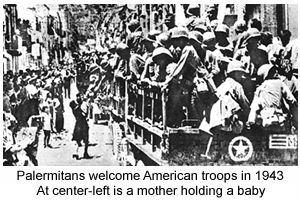
WW-II was a disaster. Following years of poverty and oppression, and in the absence of the miracles Mussolini had promised, the Sicilians welcomed the Allies as liberators in 1943. Anticipating defeat, many Sicilian Fascists had already burned their party membership cards, a tactic less effective for those who held public positions. General Alfredo Guzzoni, the Fascist whose job it was to defend Sicily, fled across the Strait of Messina and was quickly forgotten; most of his troops had already abandoned him. The victory was a costly one, as Operation Husky, the largest amphibious invasion yet undertaken, took longer than the Allies had predicted. General George Patton's American troops landed at Gela and advanced with comparatively little effort; thousands of Italian troops had already surrendered at Lampedusa without a fight. Field Marshall Montgomery's British forces met the brunt of German resistance on the Plain of Catania. (Patton later dedicated a plaque in Palermo's Anglican Church to commemorate American lives lost during the fighting, though the presence of ex-Fascists in Italy's government seems an affront to their efforts.)
It wasn't only Allied troops who perished. Though thousands of Sicilians had lost their lives, either during the bombardments or in combat, the Allied victors were viewed as a benevolent force and warmly embraced by the population. They immediately set about the task of reorganization. Political prisoners were freed from jail, journalists were allowed free expression and, most importantly for the average citizen, food was distributed.
Despite Fascist propaganda condemning Allied nations such as the US and UK as evil societies, thousands of Italians found homes in those countries after the war. This included, ironically, many men who had been prisoners of war in Allied countries, where they experienced living conditions superior to those which then existed in Italy.
In 1946, a popular referendum, in which Italian women voted for the first time, established the Italian Republic. The monarchy was thereby abolished, while titles of nobility were no longer recognised by the state. The Senate became an elective body, no longer a group of political appointees, and a genuinely democratic constitution was enacted in 1948. Following two decades of imaginary economic "progress," real economic development was so rapid that the world's economists coined the phrase "the Italian miracle" to describe it. Italy is today one of the world's eight most economically important nations. Its economic-political system is essentially socialist, though most Italians seem happily unaware of this, and many harbour strong views regarding Italy's eclectic political scene. Certain industries are gradually being privatized and investment is being encouraged.
The standard of living improved during the post-war years, when the uncontrolled construction boom of the 1960's transformed cities like Palermo and Catania into vast concrete jungles. But funds sent under the Marshall Plan to rebuild the parts of Palermo destroyed by Allied bombing were misappropriated, and problems with organized crime persist today. Visitors often ask why, in stark contrast to its historical areas, the newest sections of Palermo are so plain. Architectural evolution aside, the main reason is that during the 1960's and1970's the officials responsible for issuing building permits actually sold them (illegally, of course) to unsavory investors, with little regard for the kind of urban planning that results in pleasant parks and attractive streets. Old Palermo was planned by kings and Aristocrats, New Palermo by Mafiosis and bureaucrats.
However, historical preservation is once again an important priority for Sicilians, and serious efforts are being made to save the island's unique past. This broad cultural movement's goals focus not only on obvious assets like buildings and other monuments, but less tangible ones like the local language and pre-unification regional history (especially a more balanced consideration of the period from 1700 to 1860).
Most Sicilians are keenly aware of their island's ancient and medieval past, and many study Greek and Latin in high schools dedicated to classical subjects. Ironically, most Sicilians born after 1940 know little of historical events which occurred in their nation after 1920, since these are not taught in great detail in most Italian schools. Despite a certain degree of political autonomy, government in Sicily seems inefficient (even corrupt) to an extent far worse than that of northern Italy.
Sicily is a fascinating land full of beauty and charm, complexities and contradictions, ancient dignity and medieval splendor. If you've never thought of history as anything more than a routine academic exercise, a trip to Sicily could bring it to life. Thousands of years of history await your discovery. It's a discovery you'll cherish for a lifetime.

 ocated in
 During the 20th century the town became a colony of expatriated artist, intellectuals and writers. D. H. Lawrence stayed at the Fontana Vecchia and wrote some of his poems, stories, essays, novels (Lady Chaterlly's Lover) and a travel book, Sea and Sardinia from 1920 to 1922. The Taormina Film Festival has been held here for more that fifty years, with international stars viewing films on a screen erected in the Greek Theatre.


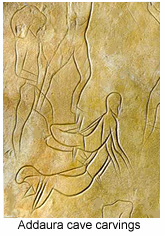 Palermo, have been dated to about 8000 BC. The
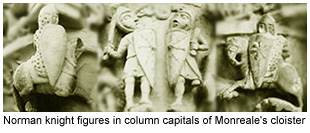 the Normans were unaccustomed to naval combat. Therefore, the conquest of Messina against Arab foes would serve as the blueprint for the battle at Hastings against the Saxons a few years later, and several knights actually fought at both battles. This was Roger's second attempt to land at Messina and, though it was successful, Palermo was still far away. It was captured only in 1071 following another epic battle. Sicily was again part of Europe.
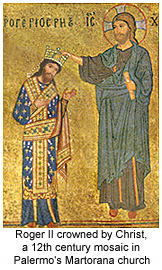 of Italy and also parts of Germany as Holy Roman Emperor, though in truth he spent little time in Sicily. It was a peaceful era, and very few Sicilian knights took part in the Crusades and the other wars of the day. Stupor Mundi was the Latin nickname given to the brilliant Emperor admired across the Mediterranean and across the world.
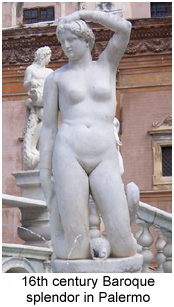 prompted the end of the few remaining mosques and synagogues, and the coercive conversion of the last Muslims and Jews.
 even though he had Italy's largest army at his disposal. Sadly, a number of high military officers had already been bribed by the Piedmontese, while others saw no reason to fight for a King who seemed reluctant to act. Weapons had already been smuggled into Sicily to support the conquest, and the British fleet commanded by Admiral Rodney Mundy prevented the Sicilian ships from attacking Garibaldi's vessels at Marsala. Additional support soon arrived from Piedmont.
 and died in Trent, then part of Austria, in 1894; his descendants were illegally exiled until the Allied liberation of Italy from Fascist control in 1943-1945.)
 by state institutions. This meant that illiteracy became more widespread, though previously its prevalence here had been no higher than in other parts of Italy.
 Italian troops had already surrendered at Lampedusa without a fight. Field Marshall Montgomery's British forces met the brunt of German resistance on the Plain of Catania. (Patton later dedicated a plaque in Palermo's Anglican Church to commemorate American lives lost during the fighting, though the presence of ex-Fascists in Italy's government seems an affront to their efforts.)